
“Is it still sensible to invest in large-cap equities when the market has not given meaningful returns for almost two years?”
One question I have been hearing more frequently from investors is exactly this. It is a valid question.
But I think there is a deeper question behind it:
If our investment horizon is 10–15 years, why do we allow the performance of the last 1–2 years to change our long-term investment decision?
This is where conviction and patience become extremely important — the real foundation of any sound long-term investment strategy.
The Problem With Judging a Long-Term Investment in Two Years
Imagine you decide to invest in equities because you believe that Indian businesses will grow over the next 10–15 years.
You have studied the Indian stock market. You understand the fundamentals. You believe corporate earnings will grow, consumption will increase, productivity will improve and businesses will become larger.
But then the market moves sideways for two years. Suddenly, you start asking:
“Should I exit?”
This is where many investors unintentionally change their investment philosophy. They started with a 10-year vision, but after two years, they start evaluating the investment like a two-year product.
That is a mismatch. Long-term investment requires long-term patience.
What Rolling Returns Actually Show
The data provides an interesting perspective. Based on daily rolling returns from June 1999 to June 2025, the Nifty 50 Total Return Index — the benchmark index for India’s stock market — had positive annualised returns in 100% of the observed 7-year rolling periods. Over 10-year rolling periods, the figure was also 100%.
| 100% Positive 7-Year Rolling Returns | 100% Positive 10-Year Rolling Returns | 1999–2025 Daily Rolling Return Data Window |
This does not mean equities cannot fall or that future returns are guaranteed. It simply shows something important: the probability of a satisfactory outcome has historically improved significantly as the investment horizon increased. And that is exactly why time matters.
Think About Gold
Let us take another asset class that many Indians consider a long-term store of value: Gold.
Suppose you believe investing in gold is a good idea and decide to keep some Gold in your portfolio — whether through buying gold physically, a Gold ETF, or another way to invest in gold.
Now imagine that Gold remains almost range-bound for several years. Would you say:
“Gold has not performed for three years. Therefore, I should remove it from my portfolio.”
If you did that, you might miss the subsequent period of strong performance. The same principle applies to equities. An asset class does not become bad simply because it has gone through a period of consolidation.
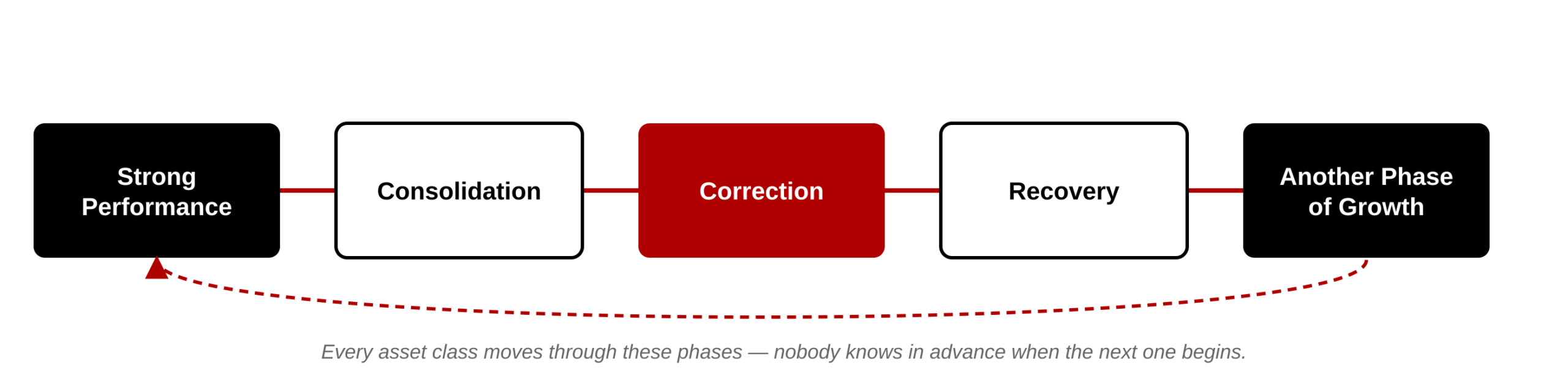
Every asset class goes through phases. The problem is that investors often want to participate only in the growth phase — and unfortunately, nobody gets to know in advance when that phase will begin.
The Market Doesn’t Pay Us for Being Right Every Year
This is perhaps the most important lesson. Suppose an investor expects 12% annualised returns over 15 years. That does not mean the market will give 12% + 12% + 12% + 12% every single year.
It could look more like: +25%, –10%, +4%, +18%, –7%, +2%, +20…
The journey can be uncomfortable even when the destination is rewarding. This is why looking at one-year or two-year returns can sometimes create the wrong conclusion.
The latest Nifty 50 data shows that the Indian stock market index has generated the following annualised Total Return CAGR, as of February 27, 2026:
| Period | Nifty 50 TR CAGR | Data As Of |
| 5 Years | 12.94% | 27 Feb 2026 |
| 7 Years | 14.20% | 27 Feb 2026 |
| 10 Years | 15.09% | 27 Feb 2026 |
The lesson is not that these returns will repeat. The lesson is that short-term periods can look very different from long-term outcomes.
The Real Enemy Is Not Volatility — It’s Behavioural Finance
Market volatility is visible. But the more dangerous problem is behavioural — a core idea in behavioural finance.
An investor enters with conviction. The market doesn’t perform. Doubt begins. The investor exits. And then, sometimes, the market starts recovering. This creates a painful cycle:

The investor may blame the asset class. But sometimes the problem was not the investment. The problem was the mismatch between the investment horizon and the investor’s patience.
Conviction Does Not Mean Blind Faith
There is an important distinction here. I am not suggesting that investors should hold an investment forever just because they once believed in it.
Conviction must be based on fundamentals — a principle that echoes across every serious investment philosophy, including Warren Buffett’s long-term, fundamentals-first approach to investing.
If the fundamentals change materially, the investment thesis should be reviewed. But there is a big difference between “the fundamentals have changed” and “the price hasn’t moved for two years.” These are not the same thing.
A good long-term investor should regularly ask:
- Has my investment thesis changed?
- Have the underlying fundamentals deteriorated?
- Has the valuation become unreasonable?
- Has my financial goal changed?
- Has my risk capacity changed?
If the answer to these questions is largely no, then a period of weak performance may simply be part of the journey.
Time Is Not Just a Waiting Period — This Is How Compounding Works
There is another beautiful aspect of long-term investing. Compounding needs time to do its work.
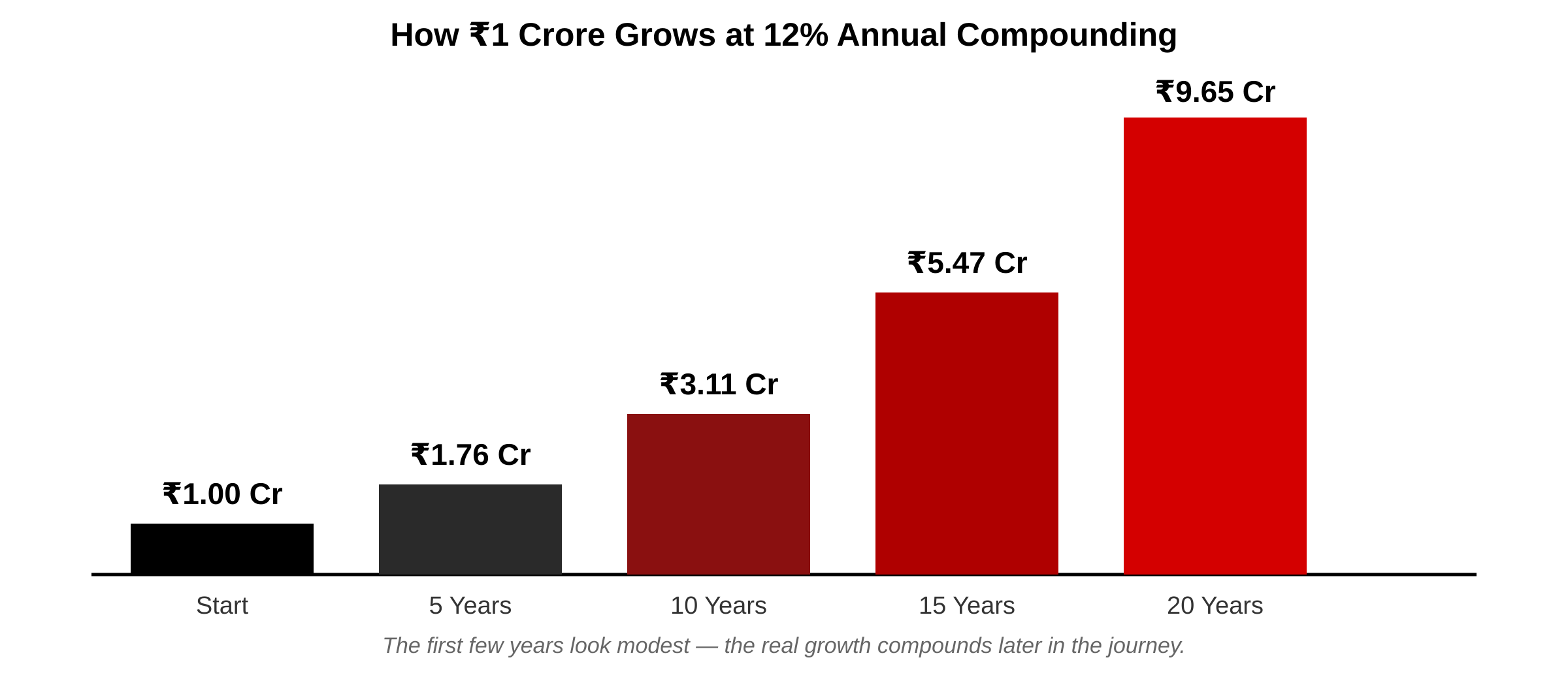
The important point is not the exact return assumption. It is what happens when time and compounding work together. The first few years may not look spectacular. But as the base becomes larger, the absolute growth becomes much more meaningful.
This is why exiting early because the first two years were disappointing can sometimes mean giving up on the most powerful part of the journey.
The Question We Should Ask
Instead of asking “What return did my investment give me in the last two years?” perhaps we should ask:
“Why did I invest in this asset class in the first place, and is that reason still valid?”
That changes the conversation completely. If you invested for retirement in 2040, why should the market’s performance in 2026 alone decide your investment strategy? If you are investing for your children’s education ten years from now, should a two-year consolidation change the entire plan?
If your financial goal is long term, your thinking also needs to remain long term.
Conviction + Patience
For me, successful long-term investing can be simplified into two words: Conviction + Patience.
Conviction tells you why you should stay invested. Patience allows you to give your investment enough time to work. Without conviction, patience becomes blind waiting. Without patience, conviction never gets enough time to prove itself.
| CONVICTION + PATIENCE Stop reacting to every phase of the market. Start focusing on the destination. |
The market will have good years. It will have difficult years. There will be periods when nothing seems to happen, and periods when everything seems to happen at once.
Our job is not to predict every phase. Our job is to understand why we are invested, align the investment with our financial goals, diversify appropriately, review the fundamentals — and then have the patience to stay the course when the fundamentals remain intact.
Because ultimately, wealth creation is rarely about finding the perfect two-year investment. It is about finding the right long-term investment strategy and giving it enough time to work.
Frequently Asked Questions
- Is long-term investing still worth it if large-cap equities haven’t moved in two years?
- Yes. Nifty 50 rolling returns from 1999–2025 were positive in 100% of all 7-year and 10-year periods, showing that the odds of a good outcome improve sharply as the holding period lengthens.
- What do rolling returns of the Nifty 50 show over 10 years?
- Based on daily rolling returns from June 1999 to June 2025, the Nifty 50 Total Return Index posted positive annualised returns in 100% of 10-year rolling periods.
- Is investing in gold a good long-term alternative to equities?
- Gold, like equities, goes through long flat phases before periods of strong performance — the lesson for both asset classes is the same: don’t judge a long-term holding on a short window.
- Why do investors exit good long-term investments too early?
- This is a behavioural finance problem, not a market problem — investors lose patience during a flat phase, exit, and the market often recovers afterward, causing regret.
- What is the actual philosophy behind long-term investing?
- It comes down to two things: conviction (a fundamentals-based reason to stay invested) and patience (giving that reason time to play out).
Data note: Nifty 50 Total Return (TR) includes dividends, unlike the commonly quoted price index. Historical returns are not a guarantee of future performance, and investors should consider their goals, risk capacity and valuation before investing.