
The NSE stock price is one of the most searched terms in the share market right now. National Stock Exchange of India (NSE) has become a listed company, and investors are checking its price along with the Nifty share price and the wider share market trend.
But a rising search count is not the same as a sound reason to invest. This guide explains the key facts about the NSE IPO, shows a simple way to analyse any stock, and covers how for investors who do not have the time or expertise for individual-stock research, index investing is one approach to understand.
Key Takeaways ■ A stock price tells you what one share costs. It does not tell you whether the business is strong or the valuation is fair. ■ A five-step framework (business, growth, financials, risk, valuation) works for NSE or any listed company. ■ A good company may still not suit your goals. Company analysis and financial planning are two separate steps. ■ If you do not have knowledge and time for stock-by-stock research, index investing is a diversified option to consider. |
NSE IPO at a Glance
Here are the key facts reported about the NSE IPO:
| Detail | Information |
| Subscription period | 17 September to 21 September 2026 |
| Price band | ₹1,700 to ₹1,785 per share |
| Final issue price | ₹1,785 per share |
| Issue size | About ₹22,562 crore (up to 12.64 crore shares) |
| Type of issue | 100% Offer for Sale (OFS) |
| Minimum retail bid | 8 shares (₹14,280 at the upper price) |
| Overall subscription | 5.71 times |
| Listing | Listed on BSE on 24 September 2026. |
Sources: exchange data as reported by Kotak Neo, Chittorgarh and Upstox. Please check the live price on the exchange.
Note: This information is provided for educational purposes only and should not be construed as investment advice or a recommendation.
Why the OFS structure matters In an Offer for Sale, the proceeds go to the existing shareholders who are selling, not to the company. The IPO therefore did not raise money to grow the business. NSE also cannot list on its own platform, so its shares trade on BSE. |
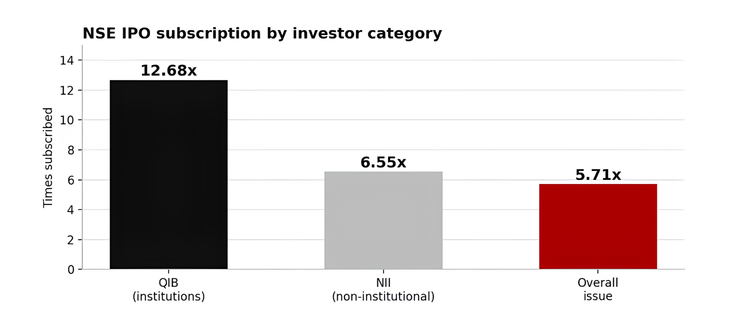
Insight An IPO’s size, subscription level and the buzz around it describe demand for the shares. They say nothing about how much the shares are worth. That is the job of analysis. |
What Does NSE Actually Do?
NSE provides electronic trading, listing, clearing and settlement services across equities, derivatives, debt and mutual funds. Its main revenue comes from transaction charges, supported by listing, clearing, data centre and licensing fees. It also earns from licensing its indices, such as the NSE Nifty 50.
https://www.nseindia.com/static/investor-relations/offer-documents
As of 30 June 2026, NSE had 132.37 million unique registered investors, along with 3,005 listed entities. These figures highlight the scale of the market infrastructure operated by NSE.
When most revenue depends on trading activity, earnings can rise and fall with the stock market trend. Ask how NSE performs when market activity is high and when it is low. The answer is part of good stock market analysis.
Why Stock Price Alone Cannot Guide Your Investment Decision
A price only shows what the market pays for one share today. It cannot answer these questions:
- How does the company make money?
- How stable are its earnings?
- What risks could hurt future performance?
- Is the current valuation already pricing in high expectations?
- Does the investment fit your financial plan?
In financial management, a sound investment decision rests on analysing the business, its risks and its valuation, and on how the investment fits your objectives. Price is only the starting point.
A 5-Step Framework for Fundamental Analysis of Stocks
This approach works for share fundamental analysis and equity fundamental analysis of any listed company.
Step 1: Understand the business model
Read the company prospectus. NSE’s Red Herring Prospectus and Prospectus are available on its investor-relations page. Look for products, customers, revenue sources and business risks.
Step 2: Identify growth drivers
Growth can come from more customers, higher activity, new products, new markets or pricing changes. Then ask the harder question: can these drivers last?
Step 3: Examine financial performance
Look at three to five years of data, not one year. Key metrics:
| Metric | What it tells you |
| Revenue and profit growth | Whether the business is expanding |
| Operating margin | How efficiently it earns |
| Return on equity (ROE) | Profit generated on shareholders’ money |
| Return on capital employed (ROCE) | How well total capital is used |
| Cash flow | Whether profits turn into actual cash |
| Debt | Financial strength and risk |
Formula: Return on Equity ROE = Net Profit ÷ Shareholders’ Equity × 100 Return on capital employed is similar but uses total capital, so it is useful for comparing companies with different debt levels. |
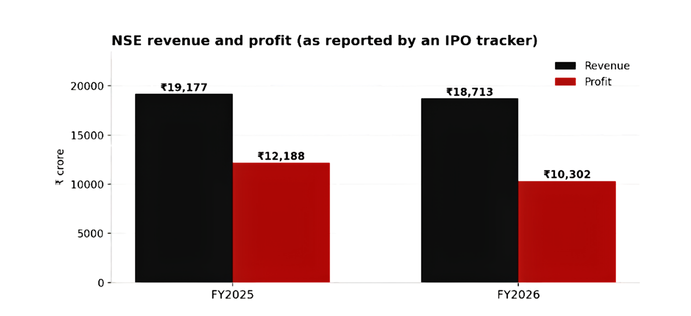
Why trends matter: NSE reported consolidated total income of ₹18,713 crore in FY2026, compared with ₹19,177 crore in FY2025. Its reported profit after tax was ₹10,302 crore in FY2026, compared with ₹12,188 crore in FY2025. Looking at year-on-year changes helps investors understand how a company’s financial performance is evolving rather than relying on a single year’s numbers.
https://www.nseindia.com/static/investor-relations/financials
Step 4: Study the risks
Competition, regulation, technology and market cycles can all affect earnings. The prospectus has a dedicated risk-factors section, and it is worth reading before any decision.
Step 5: Look at valuation, not price
Stock valuation compares the price with what the business earns and owns. A ₹100 share is not cheaper than a ₹1,000 share until you compare them on:
- Price-to-Earnings (P/E)
- Price-to-Book (P/B)
- EV/EBITDA
- Free cash flow
Corporate valuation looks at the whole company, not one share. Two companies with different share prices can be valued very differently, so compare valuation with growth, quality and peers.
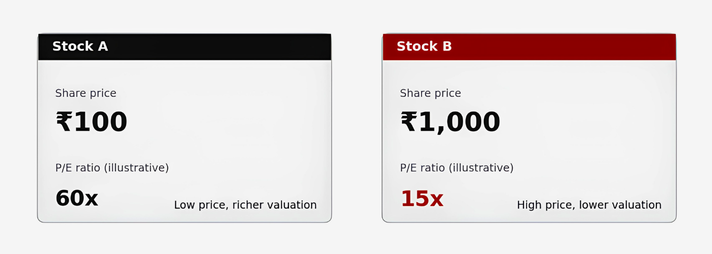
Insight A great business can still be an expensive stock. Valuation tells you how much optimism is already in the price. |
What About “Today’s Stock Market Prediction”?
Many investors search for today stock market prediction or follow a trending stock. Short-term market forecasts are uncertain and may not be a reliable basis for investment decisions. Long-term decisions are better built on analysis than on forecasts.
Is This the Best Choice to Invest Money? It Depends on You
There is no single best choice to invest money for everyone. Before investing, consider:
- Your financial goals and time horizon
- Your risk capacity and comfort with market swings
- Your existing portfolio and diversification
- Liquidity needs and upcoming commitments
Two investors can study the same company and reach different, equally reasonable conclusions.
Index Investing as an Alternative to Stock Selection
The framework above takes time and skill, and the work never really ends. Many retail investors have neither the time nor the knowledge for it. This is where index investing is often discussed.
For example, the NSE Nifty 50 is a benchmark of 50 large, actively traded Indian companies from different sectors, selected by a defined methodology. An index fund or ETF aims to mirror such an index instead of picking individual stocks.
Potential benefits
- Diversification across 50 large companies and multiple sectors
- No dependence on one company’s story
- Transparent, rules-based portfolio
- Transparent, rules-based portfolio construction.
- Its constituents are periodically reviewed and changed based on the index methodology.
Points to remember
■ A long-term, disciplined approach such as monthly SIPs is generally considered. ■ Choose based on your own goals and risk profile. |
Quick Question Before Any Investment
Does it fit my goals, time horizon and risk capacity?
Frequently Asked Questions
Q. Is the stock price a good indicator of the company’s value?
No. Price shows what the market pays per share. Value depends on earnings, growth, risk and valuation.
Q. Where can I find NSE’s official documents?
On NSE’s investor-relations page, including the prospectus and financial results.
Q. Does NSE receive money from the IPO?
No. The issue was an Offer for Sale, so proceeds go to the selling shareholders.
Q. Are index funds risk-free?
No. They are subject to market risk, though they offer diversification.
Conclusion
The NSE listing is a useful reminder that a trending stock should start your research, not end it. Understand the business, growth drivers, financials, risks and valuation, then check whether the investment fits your plan.
For investors who do not have time for detailed analysis, index investing is one of the diversified, rules-based way to take part in India’s large-cap market, though it remains subject to market risk.
| Price may start the conversation. Understanding your financial goals should drive the decision. |
Disclaimer Investment in securities market are subject to market risks. Read all the related documents carefully before investing. Registration granted by SEBI, enlistment with IAASB and certification from NISM in no way guarantee performance of the IA or provide any assurance of returns to investors. This article is for educational and informational purposes only and should not be construed as investment advice or a recommendation to buy, sell or hold any security. Past performance is not indicative of future returns. Please consult your investment adviser before making investment decisions. Full Disclaimer: https://www.finideas.com/research-paper-disclaimer Finideas Investment Advisor Pvt. Ltd.SEBI Registered Investment Adviser: INA000018045 |