
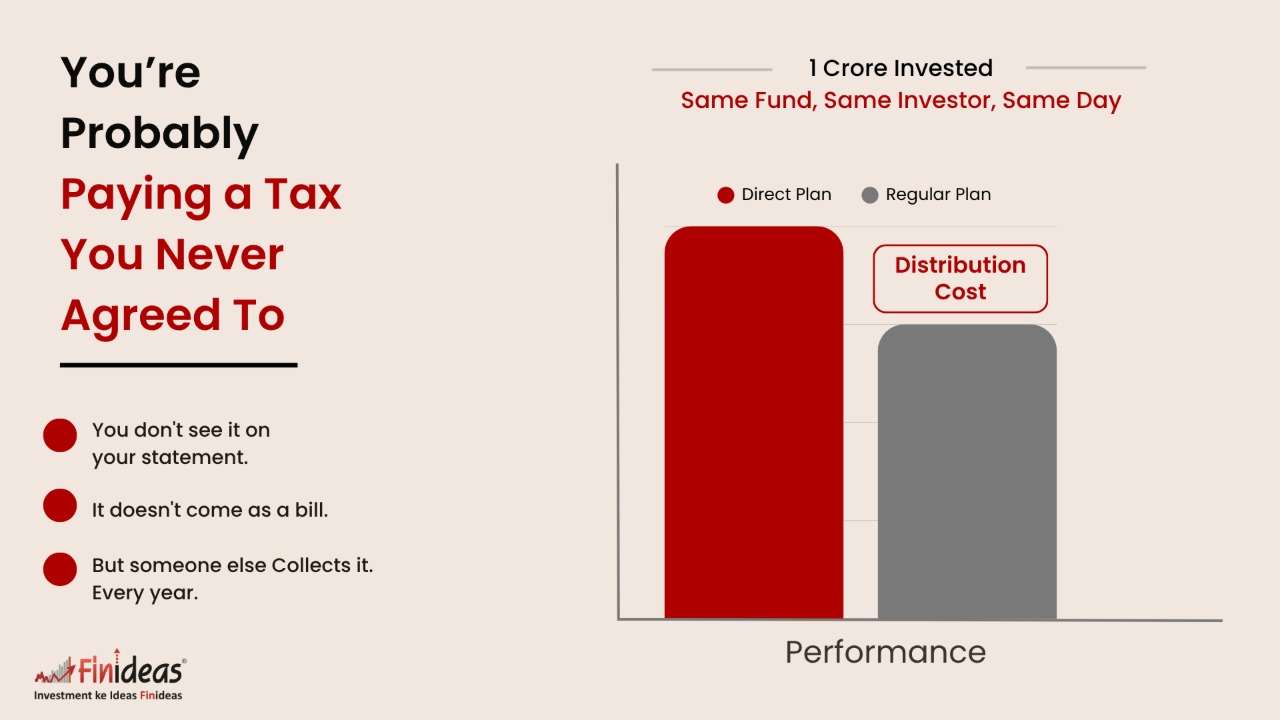
You're Probably Paying a Tax You Never Agreed To
Imagine two friends, Arjun and Priya, who both invest ₹1 crore in the exact same mutual fund, on the same day… Twenty years later, Priya has ₹6.14 crore. Arjun? Just ₹5.11 crore… That ₹1.03 crore gap (over five lakh rupees a year, silently) didn’t go to fund expenses or market losses. No bad luck. No wrong picks. The only difference: Arjun invested through a regular plan, and Priya went direct.
That ₹1.03 crore gap didn’t go to fund expenses or market losses. It went to a middleman who never once called Arjun to explain why.
This newsletter unpacks that story. By the end, you’ll know exactly what’s happening to your money, and what to do about it.
SECTION 1: WHAT ARE MUTUAL FUNDS?
A mutual fund is elegantly simple in concept. Thousands of investors pool their money together, hand it to a professional fund manager, and that manager deploys it across a diversified portfolio of stocks, bonds, or other securities, depending on the fund’s mandate.
In return for this service, the fund house charges a fee. That fee, expressed as a percentage of your invested assets annually, is called the Total Expense Ratio (TER). It is one of the most controllable and often overlooked variables in your investment journey.
Finideas Insight: “At Finideas, we believe the first step to better investing is not picking better funds. It is eliminating unnecessary costs.”
India’s mutual fund industry has grown into a financial powerhouse. The industry’s AUM stood at ₹73.73 lakh crores as of March 31, 2026, nearly triple its size from just five years ago. Monthly SIP inflows are now in the ₹25,000–30,000 crore range and rising steadily. This is no longer a niche product for HNIs and finance professionals. Mutual funds are now the mainstream vehicle through which India’s middle class is building generational wealth.
But here’s the uncomfortable truth: most of those investors are paying more than they need to. And the reason is beautifully (almost frustratingly) simple.
¹ AMFI India: Industry AUM Data, 2025–2026 | amfiindia.com
² AMFI India: Monthly SIP Contribution Data, 2025–2026 (SIP inflows crossing ₹30,000 crore) | amfiindia.com
SECTION 2: THE TWO STRUCTURAL TYPES, OPEN-ENDED AND CLOSE-ENDED
Before we get to the Direct vs. Regular debate, it helps to understand how mutual funds are structured. There are two primary variants:
Open-Ended Funds
The overwhelming majority of mutual funds in India are open-ended. You can enter or exit at any time, buying or redeeming units at the prevailing Net Asset Value (NAV). There is no fixed maturity date, and the fund continuously issues or redeems units based on investor demand. SIPs (Systematic Investment Plans) run on open-ended funds.
Close-Ended Funds
Close-ended funds have a fixed corpus and a defined maturity period, typically 3 to 7 years. Units are issued only during a New Fund Offer (NFO) and are listed on stock exchanges for secondary market trading. They appeal to investors who want lock-in discipline or exposure to a specific theme at a defined entry point.
For most retail investors reading this, open-ended funds are the everyday reality. And it is within open-ended funds that the most important (and most overlooked) choice exists: Direct vs. Regular.
³ SEBI Investor Education Portal: Regular and Direct Mutual Funds | investor.sebi.gov.in
SECTION 3: THE SAME FUND. TWO PRICES. ONE SILENT WEALTH DRAIN.
Here is something that surprises most people: every mutual fund scheme in India has two plans: Direct and Regular. Same fund manager. Same portfolio. Same stocks and bonds. The fund is identical in every meaningful way, except one: the price you pay to hold it.
Direct plans were introduced on January 1, 2013, following a SEBI directive. The logic was to allow investors who wanted to bypass intermediaries to do so, and be rewarded for it through a lower expense ratio.
“The portfolio is the same. The fund manager is the same. Only the cost structure is different, and that difference compounds silently over decades.”
Direct Plans: No middleman, no commission
In a direct plan, you invest directly with the Asset Management Company (AMC), through their website, app, or via a SEBI-registered Investment Adviser (RIA) who charges a transparent, upfront advisory fee. Because there is no distributor in the chain, the AMC has no commission to pay out. That saving is passed on to you as a lower TER. Your NAV is higher. Your returns are better.
Regular Plans: Convenience with a hidden price tag
In a regular plan, you invest through a broker, bank, or financial distributor. They earn a trail commission, typically in the 0.5%–1% annual range depending on the fund and distributor of your assets per year, paid by the AMC for as long as you stay invested. This commission is embedded inside the fund’s expense ratio, making it invisible on your statement. You never see a bill. You never write a cheque. It simply erodes your NAV day by day, silently.
As of early 2026, the mutual fund industry has over 26.6 crore folios, according to AMFI data, reflecting a massive surge in retail participation. Despite this growth, a large majority of investors still remain in regular plans, continuing to pay embedded commissions. That’s a staggering number of investors unknowingly paying more than they need to.
| Feature | Direct Plan | Regular Plan |
|---|---|---|
| Expense Ratio | Lower (no commission) | Higher (includes distributor commission) |
| NAV | Higher | Lower |
| Who buys it | Investor directly (AMC / platform) | Via broker / agent / bank |
| Guidance | Self-directed (or paid RIA) | Included via distributor |
| Long-term returns | Higher (due to lower costs) | Lower by ~0.5?1% p.a. |
| Ideal for | Informed, independent investors | First-timers / guidance seekers |
⁴ AMFI India: Mutual Fund Industry Data (Total Folios ~26.6+ crore, Jan–Feb 2026) | amfiindia.com
⁵ Mirae Asset Mutual Fund: Direct vs Regular – Expense Ratio Differences (0.5%–1% range) | miraeassetmf.co.in
⁶ Groww: Direct vs Regular Mutual Fund – NAV and Return Differences Explained | groww.in
SECTION 4: THE COMPOUNDING COST: WHAT THE NUMBERS ACTUALLY SAY
Let’s make this concrete. The SEBI Investor Education Portal illustrates the impact clearly with a simple example. Suppose you invest ₹1,00,000 in a mutual fund with a gross annual return of 10%:
In a regular plan with an expense ratio of 1.5%, your approximate net return is 8.5%.
In a direct plan with an expense ratio of 0.5%, your approximate net return is 9.5%.
That 1% annual difference sounds negligible. It is not. Here is what compounding does to it over time:
| Metric | Direct Plan (0.5% TER) | Regular Plan (1.5% TER) |
|---|---|---|
| Investment | Rs. 1,00,00,000 | Rs. 1,00,00,000 |
| Gross Return (10% p.a.) | 10% | 10% |
| Effective Return After TER | 9.50% | 8.50% |
| Value After 10 Years | Rs. 2.48 Crore | Rs. 2.26 Crore |
| Value After 20 Years | Rs.6.14 crore | Rs. 5.11 Crore |
| Wealth Lost to Costs (20 yr) | N/A | Rs. 1.03 Crore (~17%) |
Finideas Insight: “In investing, the biggest losses are not market losses. They are the costs you never notice.”
Over 20 years, a 1% higher expense ratio can silently consume 17% of your final corpus, without a single bad market day.
The pain is not felt in any single year. It is the slow, invisible siphoning of compound returns over decades. Arjun and Priya’s story at the start of this newsletter is not a hypothetical. It is the mathematical reality of every regular-plan investor who was never told about the alternative.
⁷ SEBI Investor Education: Direct vs Regular: effective return difference illustrated with ₹1,00,000 investment | investor.sebi.gov.in
⁸ ICICI Bank: Regular vs Direct Mutual Fund: return difference of 0.5–1% p.a. over long periods | icici.bank.in
SECTION 5: SO, SHOULD EVERYONE JUST SWITCH TO DIRECT?
Not necessarily. This is where nuance matters.
Choose Direct if:
You are comfortable doing your own research and fund selection. You are willing to monitor your portfolio periodically. You understand basic concepts like asset allocation, expense ratio, and risk profiling. And critically, you have the discipline to stay invested during downturns without needing someone to hold your hand.
Stick with Regular if (and only if):
Your distributor is genuinely adding value, helping you with financial planning, goal-based investing, and keeping you from panic-selling during corrections. If your agent is simply putting you in whatever fund pays the highest commission, that relationship is costing you money, not saving it.
A better middle path: hire a SEBI-registered Investment Adviser (RIA). They charge you a transparent fee, typically a flat annual amount or a percentage of your assets, and have a fiduciary obligation to act in your interest. You invest in direct plans (lower cost), but you get the guidance of a professional. You pay for advice explicitly; not via a hidden trail that runs forever.
The financial industry is not designed to tell you this. But that is exactly why we’re telling you.
⁹ PGIM India: Who Should Choose Direct vs Regular: criteria for self-directed vs guided investors | pgimindia.com
¹⁰ Mirae Asset MF: Role of financial advisors; RIA option for direct plan investors | miraeassetmf.co.in
SECTION 6: THE BOTTOM LINE
India’s mutual fund revolution is real and exciting. From ₹24.5 lakh Crore in 2019 to over ₹82 lakh crore today, ordinary Indians are finally participating in wealth creation at scale. That is a genuinely powerful shift.
But wealth creation is not just about picking the right fund. It is about keeping the returns you earn. And the simplest, most powerful lever you have is the one that gets the least attention: the plan you choose.
Direct plans don’t require a finance degree. They require awareness. If you have read this far, you now have it.
Same fund. Same manager. Same market. A different plan can mean over a crore more in your pocket over 20 years.
In the next issue, we’ll explore how to actually evaluate a mutual fund, beyond star ratings and past returns. Subscribe, share with a friend who’s still in a regular plan, and start asking the questions your distributor hopes you never ask.
For informational purposes only. Not investment advice.
Please consult a SEBI-registered investment adviser before making financial decisions.
Disclamer: https://www.finideas.com/research-paper-disclaimer